There is a particular version of Paris that only reveals itself to those who stay long enough. Not the Paris of three days and a guidebook. The one underneath it — slower, less performed, and considerably more interesting.
It takes roughly three days before the city stops performing for you and starts simply being itself. The tourist Paris — the one that looks exactly like the photographs — fades somewhere between your second visit to the same boulangerie and the moment you stop consulting your phone to find the river. Something shifts. You begin to move differently through the streets.
A week in, you have a café. Not a café you have decided upon, but one you have drifted back to without entirely meaning to. The staff recognise you now, which in Paris means a very slight nod and a coffee that arrives without your asking for it. This is a significant milestone.
Two weeks in, the rhythm has changed. You know which mornings the market at Montorgueil is worth the detour (all of them, but especially Tuesday and Saturday). You know that the covered passages are best at eleven in the morning, before the stamp collectors arrive in force and the light comes through the iron-and-glass roof at exactly the right angle. You have strong opinions about which of the neighbourhood fromageries has a better affinage, which is precisely the kind of opinion you could not have imagined yourself having six months ago.
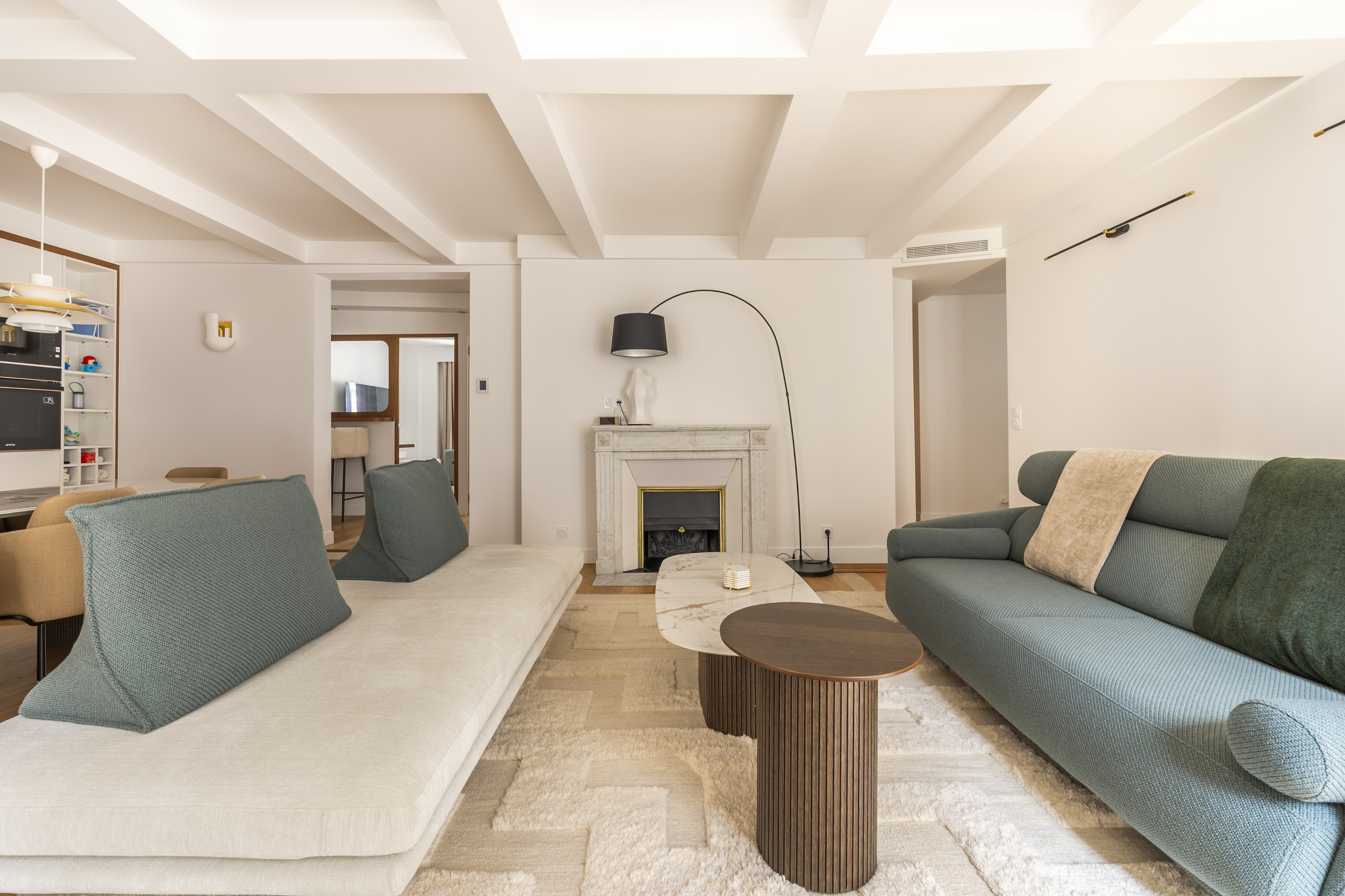
The living room at 159 rue Montmartre — a room that rewards unhurried mornings.
By the third week you are doing very little that would read as tourism. You have been to the Louvre once, briefly, to show a visiting friend the thing you thought they should see. You have had dinner at five different friends’ tables, two of whom you met at the wine shop on rue Tiquetonne. You cook twice a week with ingredients from the market. On Sundays you read for four hours without guilt, which is not something most cities allow you to do.
There is a specific quality of afternoon that Paris seems to manufacture at will — overcast, neither too cold nor too warm, the kind that makes a long lunch feel not just acceptable but morally obligatory. A hotel room cannot catch this quality. A hotel room makes you feel like a visitor even when you have been somewhere for three weeks. An apartment, properly furnished and properly sized, does something different. It makes you feel like you live here. Which, for a month, you do.
The apartment at 159 rue Montmartre sits in this logic particularly well. It is large enough that two people can spend a quiet Sunday on opposite sides of it without feeling crowded, and social enough — with a dining table that seats eight — that the friends who inevitably appear can be fed properly. The kitchen is equipped beyond what you would find in most primary residences, which matters when you are spending a month somewhere and have decided that the Montorgueil vegetables deserve better than another restaurant.
None of this is accidental. The point of staying at Arara131 is not to have a nice place to sleep after a day of sightseeing. It is to create the conditions for a genuinely different experience of Paris — the one that takes three days to reveal itself, and rewards staying for much longer.
The month goes too fast. They always do, once Paris stops performing and starts being itself.