The market street two minutes from the front door has been trading since 1645. The oyster sellers arrive at six. The best croissants at Stohrer are gone by nine. What happens in between is one of the small, perfect things about staying in this particular corner of Paris.
There is a specific quality to rue Montorgueil before the city has properly woken up. The produce arrives in wooden crates. The cheese and charcuterie displays are being assembled with a care that borders on architectural. The florist is arranging the pavement outside her shop with the focused deliberateness of someone who has been doing this for forty years, which she has. None of this is performing for your benefit. It is simply how the street starts its day.
The street itself runs for about 350 metres between rue Réaumur and rue Rambuteau, which is to say it is short enough to walk end-to-end without planning to and long enough to contain several distinct worlds. The northern end is older, quieter, more residential in character. As you move south, the terraces multiply and the atmosphere becomes gradually more festive. By noon on a Saturday it is in full swing — but by seven in the morning it belongs entirely to the people who live nearby.
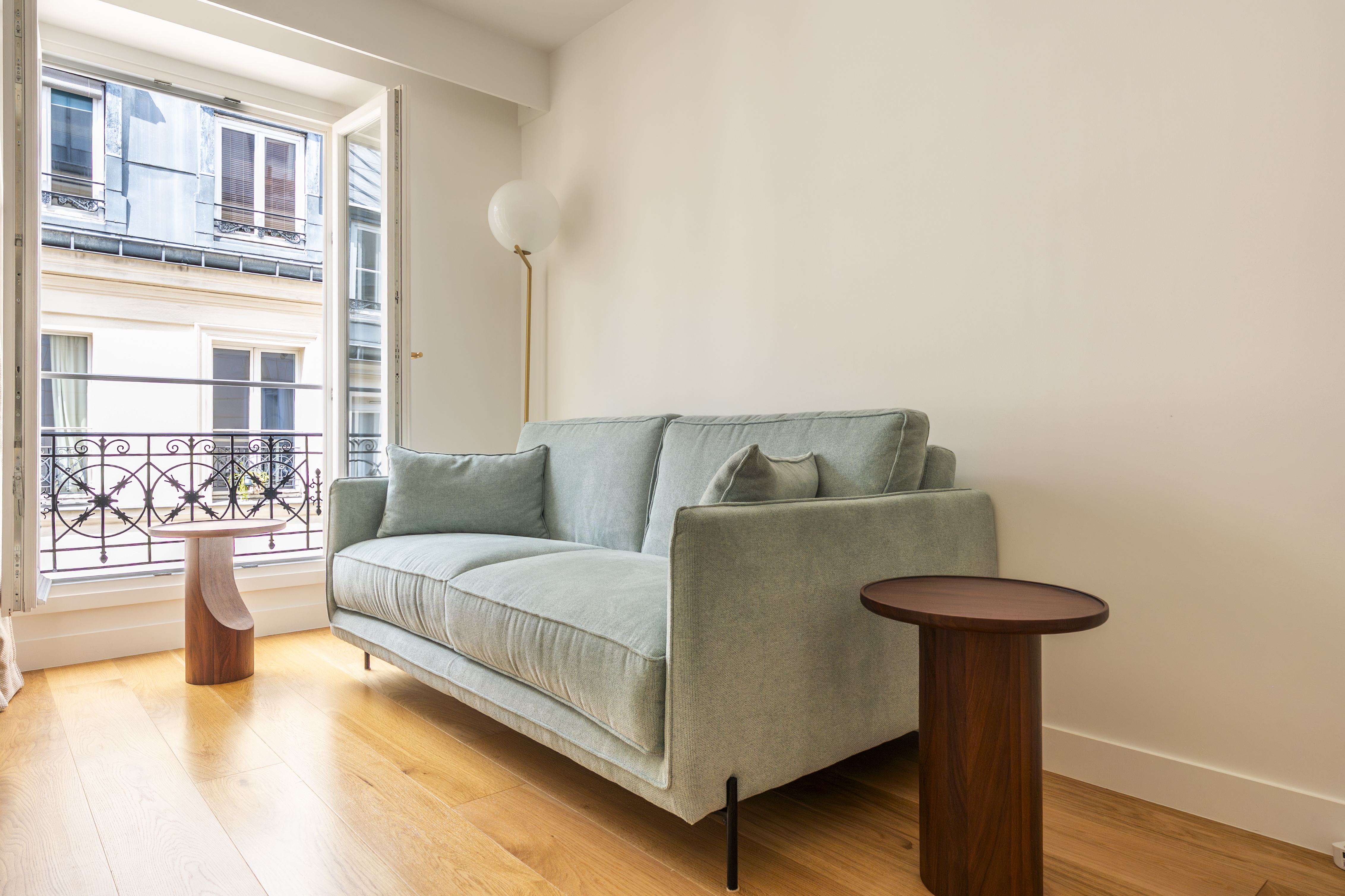
The salon privé — where the provisions from Montorgueil eventually land.
The history of the street is worth knowing, because it changes how you walk through it. Rue Montorgueil has been a commercial artery since at least the thirteenth century, when it was the main route for fish coming from the Normandy coast into central Paris. The name derives from “Mont Orgueil” — Mount Pride — which referred to a small hill that no longer exists. The covered market at the end of the street was described by Zola in Le Ventre de Paris as the most overwhelming sensory experience in the city. Modern Parisians might argue the scale has reduced, but the atmosphere has not.
What matters practically is that rue Montorgueil is two minutes on foot from the entrance of 159 rue Montmartre. In terms of what this means for daily life: you can buy vegetables, cheese, wine, bread, fish, and flowers within a single short walk without passing a single chain shop or tourist trap. You can provision a dinner for eight and spend less than you would on restaurant mark-ups, and the ingredients will be better.
We have watched guests transform over the course of a month. People who arrived thinking they would eat out every night begin cooking by the end of the first week. Not because they are being frugal — the restaurant options in this corner of the 2ème are exceptional — but because the market makes cooking irresistible. It is hard to pass a display of thirty varieties of mushroom without buying some of them.
The street quiets in the early afternoon. By two it has the particular Sunday-in-Paris atmosphere that most visitors associate with the whole city, but that in reality only appears in residential neighbourhoods where the rhythm is still set by the people who live there rather than the people who are passing through. By four the terraces are filling again. By seven in the evening the whole cycle is preparing to begin once more.
It is, like most of the things worth knowing about this part of Paris, best discovered early and returned to often.